By Cornelius Kabwe & Patson Chilufya
For many people, a diagnosis of kidney failure can feel like a moment when life suddenly changes direction. It can bring fear, uncertainty, and questions about the future.
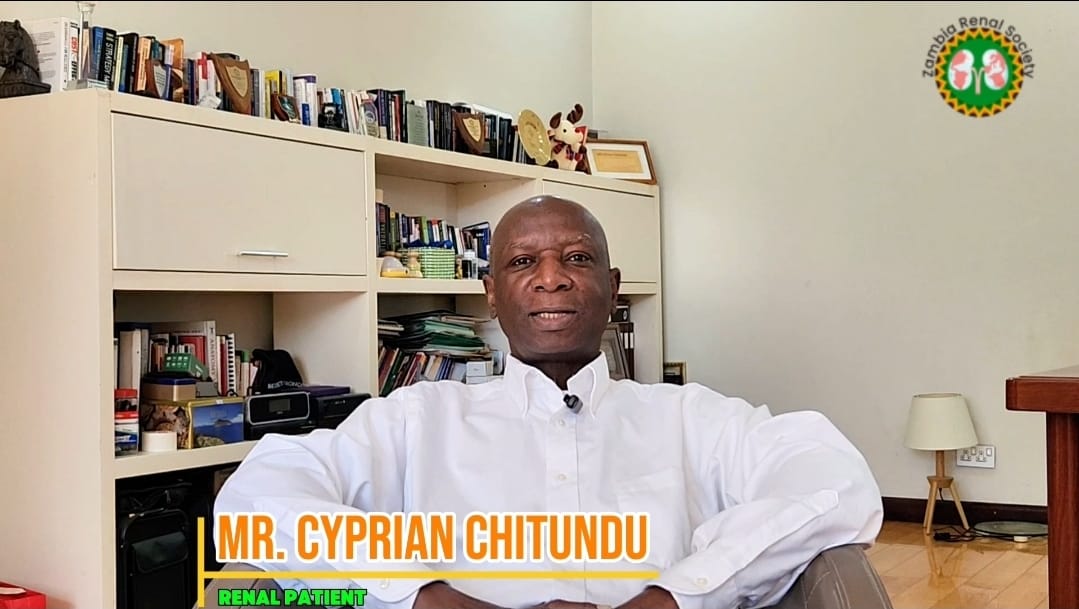
But for Mr. Cyprian Chitundu, kidney failure did not mark the end of his journey. Instead, it became the beginning of a new chapter, one that has tested his strength, deepened his appreciation for life, and strengthened his faith in God.
Through prayer, the unwavering support of his family, especially his wife, and the dedication of healthcare professionals who have walked with him through his treatment journey, Mr. Chitundu found the courage to embrace his new reality and continue moving forward with hope.
A distinguished engineer, corporate leader, and former Managing Director of ZESCO Limited from 2011 to 2013, Mr. Chitundu has spent decades building a career defined by excellence, service, and leadership.
He holds a Master of Science degree in Electrical Engineering specialising in Power Systems and Networks and is an alumnus of Harvard University’s Advanced Management Program. His professional journey has included leadership and technical roles at institutions such as Zambia Consolidated Copper Mines (ZCCM), Kariba North Bank Company Limited, and ZESCO Limited.
His expertise and contribution to the energy sector have earned him recognition, including being named African Utility Executive of the Year and receiving recognition as Best African Power Station Manager of the Year.
From leading teams responsible for powering a nation to now managing his own health journey, Mr. Chitundu continues to demonstrate the same qualities that shaped his professional career: discipline, resilience, planning, and determination.
However, in August 2024, he faced a challenge unlike any he had encountered in his professional life.
The man who had spent years solving complex organisational challenges was now facing a personal battle of his own, a diagnosis that his kidneys had failed and that he needed to begin dialysis immediately.
Yet, rather than allowing the diagnosis to define him, Mr. Chitundu chose to focus on life, purpose, gratitude, and the people who stood beside him.
Today, while undergoing regular dialysis treatment, he continues to work, travel, attend meetings, engage in professional activities, and remain active in society.
His story is not simply about kidney disease. It is about a leader who has learnt to balance treatment with purpose, medical care with faith, and a demanding schedule with the precious gift of life.
“I do so many things and work so much that if you met me on the road, you would not have a clue that I am on dialysis,” says Mr. Chitundu.
For him, dialysis is not a barrier that has stopped his life. It is a treatment that has given him another opportunity to continue living, serving, and contributing.
Mr. Chitundu’s kidney journey started much earlier during his active working years. He recalls experiencing occasional back problems, which led him to seek medical attention.
“When I was working, I would feel a back problem and subsequently go for tests. The doctors would tell me that my kidney function was okay, but there was some protein in my urine,” he recalls.
At the time, he did not fully understand the significance of that finding.
“Later, I discovered that there should actually be zero protein in urine. That was an indication that something was not right.”
Despite this early warning sign, he continued with his professional responsibilities, remaining active and committed to his work.
The turning point came in August 2024 when his wife returned from visiting their son abroad and found him at home with severely swollen legs.
“At first, I thought it was just one of those things. I thought maybe it was a reaction from something I had eaten,” he says.
But his wife immediately became concerned.
“She said no, it cannot simply be what I had eaten.”
Her concern prompted her to contact their close family friend, Dr. Kondwani Mateo and his Counterpart Dr. Mbiya, who quickly came to assess him.
After examining him, they suspected that the swelling could have been linked to a serious medical condition, including possible heart failure, kidney failure, or a circulation problem. Although they could not immediately confirm the cause, they advised further investigations.
Dr. Mbiya provided initial treatment, while Dr. Mateo insisted on collecting blood samples and advised Mr. Chitundu to report to the University Teaching Hospital (UTH) the following day.
When he arrived at UTH, the results were already available.
He sat with nephrologist Dr. Agrey Mweemba and other doctors, who explained that his kidneys had failed and that he needed to start dialysis immediately.
“At that point, I was in shock. I felt like my world had come to an end. I asked myself, my kidneys have failed, what are we going to do?”
But in that difficult moment, he found reassurance and hope.
Dr. Mweemba explained that dialysis was not the end of life, but a treatment that could help him continue living. After discussions with his wife and family, Mr. Chitundu accepted the new reality and began treatment.
When he later reviewed his results, he understood how serious his condition had been.
His haemoglobin level was 5.3, while his creatinine was around 2000, showing that his kidneys were no longer functioning properly.
He was admitted, received a blood transfusion, and started dialysis.
Slowly, his condition improved.
After the first dialysis sessions, his blood levels increased, his strength returned, and he began feeling better.
Following his discharge, he continued dialysis three times a week, with each session lasting about four hours.
The next challenge was finding a balance between treatment and his busy lifestyle.
For a man who has spent much of his life managing demanding responsibilities, dialysis required him to develop a new routine. He had to plan his days carefully, ensuring that his health remained a priority while continuing with his professional commitments.
Due to the number of patients requiring dialysis services at UTH, he was encouraged to consider another centre where he could comfortably continue treatment.
He eventually moved to the National Heart Hospital, where he met Matron Hildah Mwila and a dedicated renal care team.
“I was received very well by a very hardworking team, and I was given an 11 o’clock morning slot.”
That support helped him integrate dialysis into his lifestyle.
Today, Mr. Chitundu continues working and travelling for professional engagements. His calendar remains active, but he has learnt how to plan around dialysis.
“If you were to meet me on the road, you would not have a clue that I am on dialysis,” he says.
His work has taken him to different parts of Zambia, and wherever he travels, he ensures that he has access to dialysis services.
“I have been able to access dialysis services in different parts of the country. I have received treatment at UTH, National Heart Hospital, Chisali, Livingstone Teaching Hospital, Kitwe Teaching Hospital, and other dialysis centres.”
For him, the availability of dialysis services and the commitment of healthcare workers have been a blessing.
He credits the support of doctors, nurses, and renal teams who have helped him continue living an active life.
He expresses gratitude to Dr. Agrey Mweemba, Dr. Kajimoto, Dr. Mputu, renal nurses at UTH, National Heart Hospital, and many other healthcare workers who continue caring for patients living with kidney disease.
“I thank the Government for these great minds in our healthcare system who continue helping people like me.”
Living with kidney failure has also taught him the importance of discipline and making healthy choices.
After his catheter was inserted, he was advised on activities he needed to avoid, including lifting heavy things, and he adjusted accordingly.
He also changed his diet and became more conscious about his health.
“There were foods I was advised not to eat, and I adjusted. It is important to eat the right food, exercise, keep healthy, and follow doctors’ advice.”
For Mr. Chitundu, resilience is not just a word. It is a way of life.
“Resilience is an attitude. When I found out I had kidney failure, I could have given up. But once you give up, your mind also gives up.”
He believes that people facing chronic illnesses should not allow their condition to take away their hope.
“Your attitude towards life is important. You have to take one day at a time.”
For him, every morning is a gift from God.
“When I wake up each morning, I simply say a prayer: ‘God, this is the day you have made, and I will be glad and rejoice in it.’”
His faith has remained a source of strength throughout his journey.
“When you wake up, thank God for the breath in your lungs. There are people who cannot walk, cannot breathe on their own, or cannot get out of bed. Every day is a blessing.”
Mr. Chitundu’s story is a reminder that a kidney failure diagnosis does not have to bring life to a standstill.
While kidney disease changed his routine, it did not take away his purpose. Dialysis became part of his life, but it did not become the definition of his life.
Through treatment, discipline, medical support, family encouragement, and faith in God, he has continued to work, travel, attend meetings, spend time with his loved ones, and contribute to society.
For many people, hearing the words “you need dialysis” can be frightening. But Mr. Chitundu’s journey shows that dialysis is not the end of life. It is a life-sustaining treatment that gives people an opportunity to continue pursuing their dreams, responsibilities, and passions.
Every dialysis session is a reminder of the importance of healthcare and the gift of a second chance. It allows patients to continue living meaningful lives as they await further possibilities, including kidney transplantation.
Mr. Chitundu continues his dialysis journey with hope, knowing that one day he may receive a kidney transplant. But while waiting for that day, he chooses to live fully and make every moment count.
Behind every dialysis patient is a story, not just of illness, but of courage, family, faith, and determination. They are parents, professionals, leaders, and community members who still have dreams to achieve.
For Mr. Chitundu, dialysis has not taken away his identity. He remains the same energetic, committed, and passionate individual who continues to make an impact.
His story is more than a story about kidney failure. It is a story of resilience, hope, and the power of choosing life every single day.
The same man who once helped keep Zambia’s energy flowing now inspires others by showing that even when life presents challenges, the human spirit can continue to shine.
Because sometimes, the greatest power is not only the ability to light a nation, but the courage, faith, love, and determination that keeps a person’s own light burning.
Tap play and hear more of the story behind the mission.
Renal Society of Zambia of Zambia
Communications